Managing dozens of invoices each month often turns into a time-consuming maze for freelancers and small business owners. With high billing volumes and recurring vendor payments, staying organized can feel nearly impossible without the right strategy. Invoice consolidation replaces scattered statements and manual processing with a single, centralized solution that brings order to financial chaos. Discover how this approach can simplify your workflow, improve payment accuracy, and give you back hours every billing cycle.
Table of Contents
- Defining Invoice Consolidation In Modern Business
- Types Of Invoice Consolidation And Key Differences
- How Invoice Consolidation Works Step By Step
- Benefits For Small Businesses And Freelancers
- Common Challenges And Pitfalls To Avoid
Key Takeaways
| Point | Details |
|---|---|
| Invoice Consolidation Improves Efficiency | Combining multiple invoices into one reduces administrative workload and enhances financial management. |
| Tailored Strategies are Essential | Different types of consolidation, such as departmental or subsidiary, cater to unique business needs. |
| Technology is Key to Success | Advanced accounting platforms automate the consolidation process, enhancing accuracy and visibility. |
| Be Prepared for Challenges | Common pitfalls, such as data integration issues, must be proactively managed to ensure smooth billing operations. |
Defining Invoice Consolidation in Modern Business
Invoice consolidation represents a strategic financial approach that transforms how businesses manage billing processes. At its core, invoice consolidation means combining multiple vendor or departmental invoices into a single, comprehensive transaction, streamlining complex accounting workflows. Consolidated billing methods enable organizations to simplify their financial management and reduce administrative overhead.
The modern business landscape demands efficiency, and invoice consolidation delivers precisely that. By aggregating numerous individual invoices into one centralized document, companies can:
- Reduce manual data entry and processing time
- Minimize the risk of late or duplicate payments
- Improve financial visibility across departments
- Enhance overall accounting accuracy
- Simplify reconciliation and reporting processes
Businesses utilizing invoice consolidation typically leverage technology platforms that automatically track, compile, and generate unified billing statements. These solutions integrate seamlessly with existing accounting systems, allowing real-time tracking of expenses and payments across multiple accounts or subsidiaries.
Invoice consolidation transforms chaotic billing processes into streamlined, manageable financial workflows.
Financial Benefits emerge quickly when organizations adopt consolidated invoicing strategies. Companies can reduce administrative costs, improve cash flow management, and gain unprecedented insights into spending patterns. Small businesses and freelancers particularly benefit from this approach, as it minimizes time spent on repetitive billing tasks.
Pro tip: Start by mapping out all your current invoice sources and identifying potential consolidation opportunities to maximize your financial efficiency.
Types of Invoice Consolidation and Key Differences
Invoice consolidation is not a one-size-fits-all solution. Different businesses require unique approaches tailored to their specific operational needs. Billing consolidation strategies vary widely, reflecting the diverse financial structures of modern organizations.
The primary types of invoice consolidation include:
- Departmental Consolidation: Combining invoices across different internal departments
- Subsidiary Consolidation: Aggregating billing for multiple business units or subsidiary companies
- Subscription-Based Consolidation: Grouping recurring charges for service-based businesses
- Multi-Vendor Consolidation: Streamlining invoices from various external service providers
- Cross-Account Consolidation: Unifying billing across multiple financial accounts
Each consolidation type addresses unique business challenges. Departmental consolidation helps large corporations track internal spending, while subsidiary consolidation provides comprehensive financial visibility for complex corporate structures. Subscription-based businesses benefit from simplified recurring billing management that reduces administrative complexity.

Here is a quick comparison of consolidation types and the organizations they suit best:
| Consolidation Type | Best For | Unique Advantage |
|---|---|---|
| Departmental Consolidation | Large enterprises | Tracks spending across departments |
| Subsidiary Consolidation | Corporate groups | Centralizes multi-entity finances |
| Subscription-Based | Service businesses | Simplifies recurring payment cycles |
| Multi-Vendor Consolidation | Any organization | Minimizes separate vendor invoices |
| Cross-Account Consolidation | Companies with divisions | Unified billing for multiple accounts |
Not all invoice consolidation methods are created equal – choose a strategy that matches your specific business architecture.
Technological advancements have made these consolidation strategies more accessible than ever. Modern accounting platforms can automatically categorize, compile, and generate unified invoices, reducing manual intervention and minimizing human error. Small businesses and freelancers can now leverage sophisticated tools that were previously available only to large enterprises.
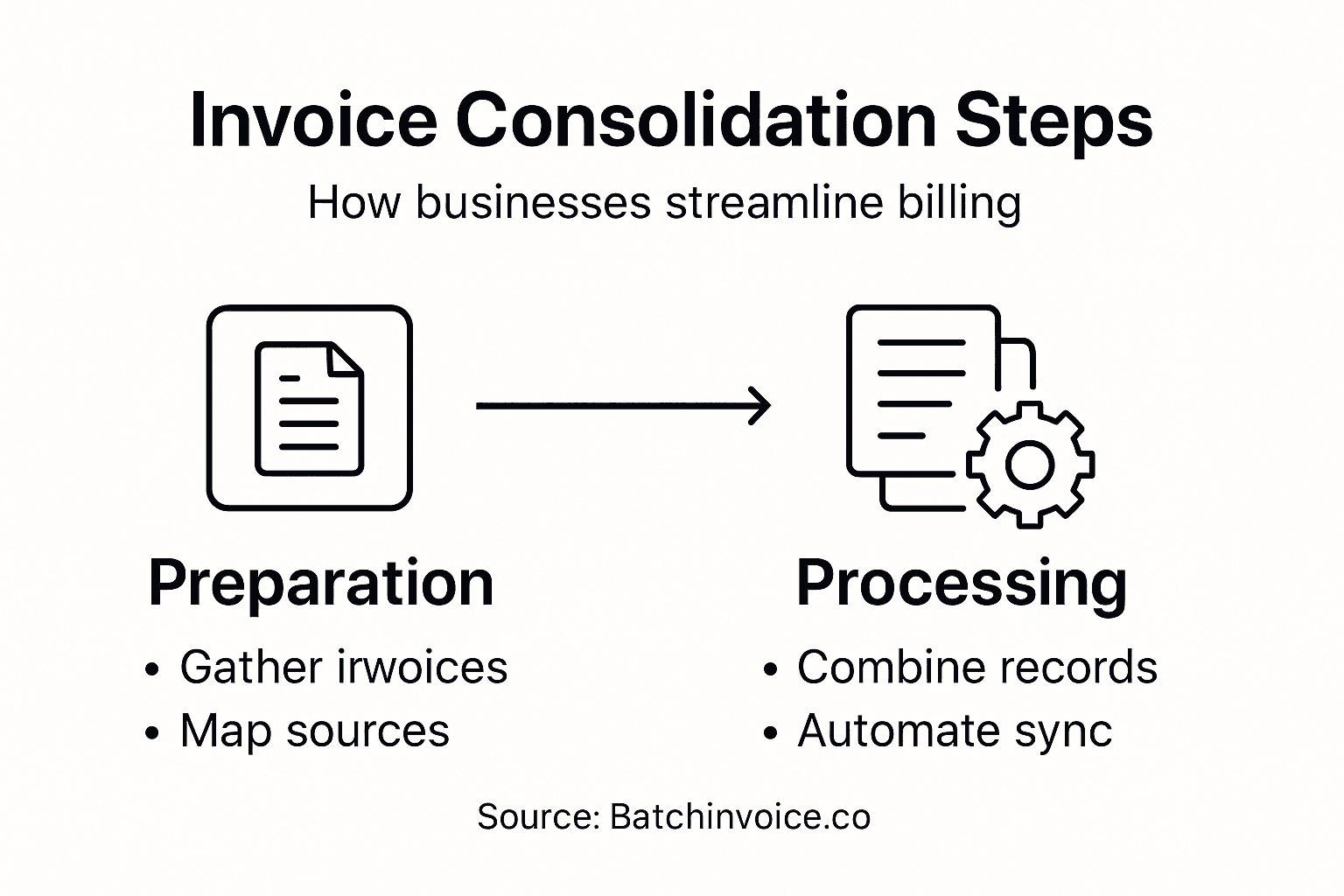
Pro tip: Analyze your current invoicing workflow and identify which consolidation type best matches your organization’s financial complexity and reporting requirements.
How Invoice Consolidation Works Step by Step
Understanding the mechanics of invoice consolidation requires breaking down the process into strategic, interconnected stages. Consolidated billing techniques transform complex financial workflows into streamlined, efficient systems that dramatically reduce administrative overhead.
The invoice consolidation process typically involves five critical stages:
- Customer Enrollment: Registering and linking multiple accounts or services within the system
- Usage Tracking: Monitoring and recording transactions across different accounts
- Data Aggregation: Collecting and compiling transaction details from various sources
- Invoice Generation: Creating a comprehensive, unified billing document
- Payment Processing: Executing consolidated payment collection
Each stage plays a crucial role in transforming fragmented billing into a cohesive financial management approach. The enrollment phase establishes the foundation by connecting various accounts, while usage tracking ensures accurate, real-time monitoring of all transactions. Data aggregation becomes the critical bridge, synthesizing information from multiple sources into a coherent financial narrative.
Successful invoice consolidation turns complex financial data into clear, actionable insights.
Technological platforms have revolutionized this process, enabling businesses to automate most steps with minimal manual intervention. Advanced software can now seamlessly integrate data from different departments, vendors, and financial accounts, generating precise consolidated invoices that provide unprecedented financial visibility. Small businesses and freelancers particularly benefit from these sophisticated yet user-friendly systems that were once accessible only to large corporations.
Pro tip: Select an invoice consolidation platform that offers robust integration capabilities and can adapt to your specific business’s unique financial ecosystem.
Benefits for Small Businesses and Freelancers
Small businesses and freelancers operate in a challenging financial landscape where every minute and dollar counts. Consolidated billing strategies offer a lifeline, transforming chaotic invoice management into a streamlined, efficient process that saves time and reduces administrative burden.
The key benefits for small businesses and freelancers include:
- Reduced Administrative Time: Minimize hours spent managing multiple invoices
- Lower Error Rates: Decrease chances of duplicate or missed payments
- Improved Cash Flow Visibility: Get a comprehensive view of financial transactions
- Enhanced Vendor Relationship Management: Simplify tracking and payment processes
- Cost-Effective Financial Management: Reduce overhead associated with invoice processing
Each benefit directly addresses the unique challenges faced by small-scale professionals. Managing numerous invoices from different clients or vendors can quickly become overwhelming, consuming valuable time that could be spent on core business activities. Invoice consolidation acts as a strategic solution, allowing freelancers and small business owners to focus on growth rather than getting lost in paperwork.
Small businesses thrive when financial complexity is transformed into simplicity.
Modern technological platforms have democratized advanced invoicing solutions, making sophisticated tools accessible to even the smallest operations. These systems can automatically categorize, compile, and track invoices across multiple sources, providing real-time insights that were once available only to large corporations. The result is a more agile, responsive approach to financial management that can significantly improve a business’s operational efficiency.
Pro tip: Invest in an invoicing platform that offers scalability, ensuring your financial management tools can grow alongside your business.
Common Challenges and Pitfalls to Avoid
Invoice consolidation, while powerful, is not without its potential complications. Billing process challenges can quickly derail even the most well-intentioned financial strategy, making awareness and proactive management critical for success.
The most significant challenges businesses encounter include:
- Inconsistent Billing Cycles: Misaligned payment schedules causing reconciliation difficulties
- Data Integration Problems: Incompatible systems leading to incomplete or inaccurate invoicing
- Payment Tracking Complexity: Difficulty monitoring multiple consolidated transactions
- Vendor Communication Gaps: Potential misunderstandings about consolidated billing processes
- Technological Compatibility Issues: Challenges integrating different accounting platforms
Each challenge represents a potential landmine in the invoice consolidation journey. Small businesses and freelancers must develop robust strategies to mitigate these risks, ensuring smooth financial operations. The key lies in understanding potential friction points and implementing proactive solutions before they escalate into significant problems.
The table below summarizes common consolidation challenges and potential solutions:
| Challenge | Potential Solution | Business Impact |
|---|---|---|
| Inconsistent Billing Cycles | Align payment dates | Smoother cash flow |
| Data Integration Problems | Use interoperable platforms | Improved invoice accuracy |
| Payment Tracking Complexity | Adopt advanced tracking tools | Easier reconciliation |
| Vendor Communication Gaps | Set clear consolidation policies | Fewer misunderstandings |
| Technological Compatibility Issues | Choose scalable accounting software | Seamless system integration |
Successful invoice consolidation requires more than technology – it demands strategic thinking and meticulous planning.
Technological solutions have emerged to address many of these challenges, offering sophisticated tools that can automatically detect inconsistencies, validate data, and streamline communication processes. Advanced platforms now provide real-time tracking, automated error detection, and seamless integration capabilities that can significantly reduce the manual intervention required in complex billing scenarios.
Pro tip: Conduct a comprehensive audit of your current invoicing processes before implementing consolidation, identifying potential integration challenges and communication gaps.
Simplify Your Billing with BatchInvoice.co Today
Invoice consolidation is vital for reducing administrative headaches and improving cash flow visibility. If you struggle with managing multiple invoices, inconsistent billing cycles, or complex payment tracking as discussed in our Uncategorized Archives – BatchInvoice article, BatchInvoice.co provides exactly the solution you need. Our platform automates invoice creation, offers bulk processing from text or voice notes, and seamlessly integrates with top accounting platforms to streamline your entire billing process.
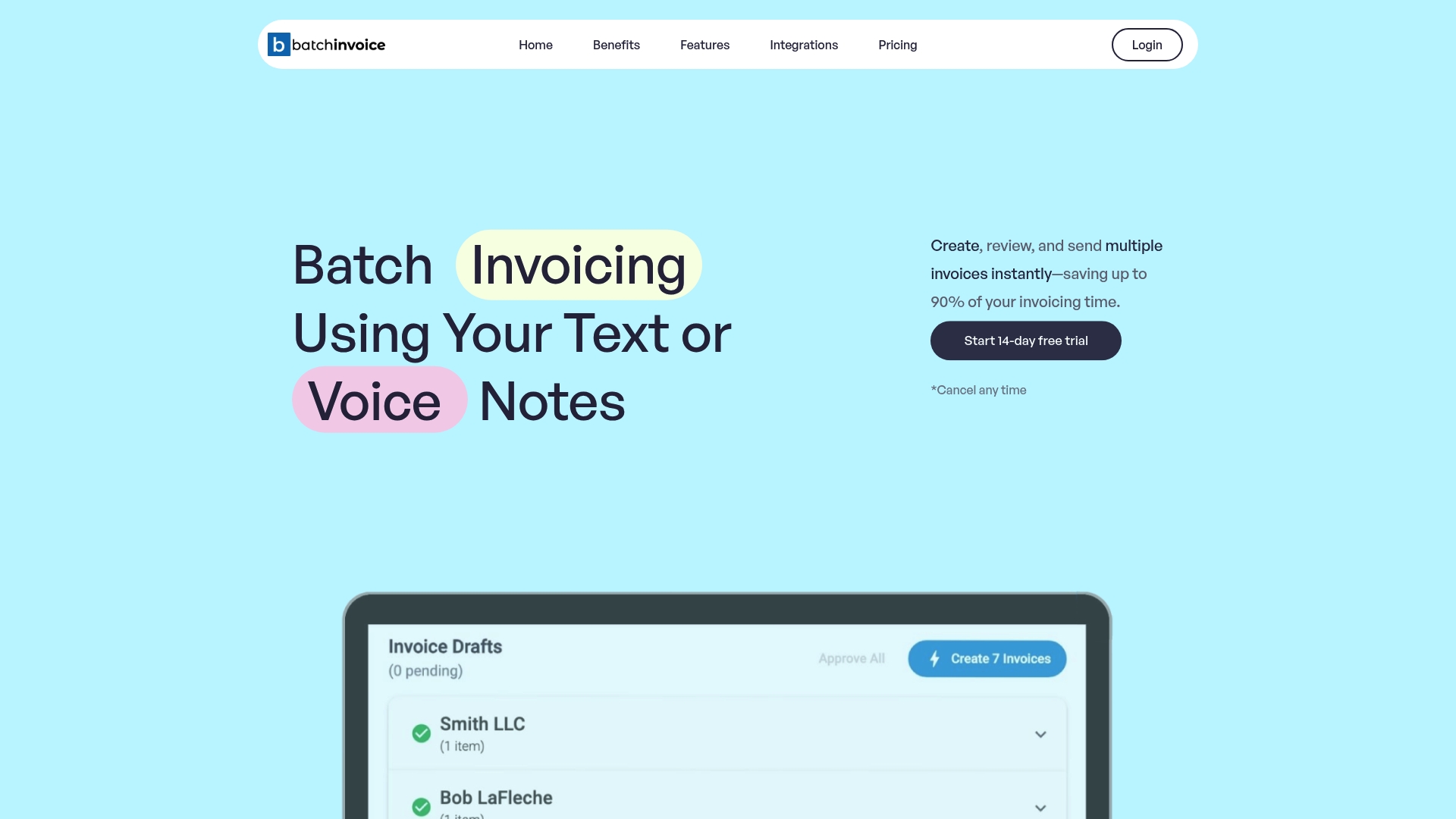
Take control of your financial workflow now by choosing BatchInvoice.co. Save up to 90 percent of your invoicing time and eliminate errors caused by manual entry. Whether you are a freelancer or a small business owner, simplify your billing, reduce overhead, and improve cash flow management today. Visit https://batchinvoice.co to get started with a free trial and experience effortless invoice consolidation tailored to your needs.
Frequently Asked Questions
What is invoice consolidation?
Invoice consolidation is a financial strategy that combines multiple invoices from vendors or departments into a single document, streamlining the billing process and improving financial management.
How does invoice consolidation benefit small businesses?
Small businesses benefit from invoice consolidation by reducing administrative time spent on managing multiple invoices, lowering error rates, improving cash flow visibility, and enhancing vendor relationship management.
What are the different types of invoice consolidation?
The primary types of invoice consolidation include departmental consolidation, subsidiary consolidation, subscription-based consolidation, multi-vendor consolidation, and cross-account consolidation, each addressing specific business needs.
What challenges might arise with invoice consolidation?
Challenges can include inconsistent billing cycles, data integration problems, payment tracking complexities, vendor communication gaps, and technological compatibility issues. Proactive management and strategic planning can help mitigate these risks.